 Add to Chrome
 Add to Firefox
 Add to Edge
MC-PDD: Masked Corpus-Level Pretraining Data Detection for Black-Box Large Language Models
Jun 06, 2026
Pretraining is fundamental to the development of Large Language Models (LLMs), yet the opacity of pretraining data complicates model analysis and raises ethical, legal, and fairness concerns. Detecting whether specific datasets were used during pretraining is, therefore, critical. Existing state-of-the-art methods typically rely on access to model probability distributions, making them unsuitable for closed-source LLMs that provide only input-output interfaces. To address this limitation, we introduce Masked Corpus-level Pretraining Data Detection (MC-PDD), a novel method inspired by the masked language modeling paradigm. MC-PDD masks highly specific tokens in each text and prompts the LLM to predict the missing content. It then assesses whether the difference in prediction hit rates between a candidate corpus and a reference non-member corpus is statistically significant. Based on this comparison, MC-PDD determines whether the candidate texts were likely included in the model's pretraining data. Experimental results demonstrate clear and consistent differences in prediction hit rates between pretrained and unseen data across three datasets, for both open-source and closed-source LLMs. Despite operating under a stricter black-box setting, MC-PDD achieves performance comparable to existing detection methods. Our approach enables practical applications such as model auditing and data copyright verification using only standard API access. Upon acceptance, we will publicly release the code and datasets.

Worlds Within Words: Translating Culture in Ancient Chinese Texts with Multi-Agent Coordination
May 31, 2026Large language model (LLM)-based machine translation has advanced cross-cultural communication, yet it still struggles with culture-loaded words (CLWs) in ancient Chinese texts. The challenge extends beyond lexical alignment to deciding when and how culture-dependent knowledge should be explicated for readers lacking relevant background. Literal translation often preserves surface forms while missing underlying concepts, whereas over-explicitation harms conciseness and readability. To address this problem, we formulate CLW translation as a selective explicitation task and propose \textbf{MACAT}, a \textbf{M}ulti-\textbf{A}gent \textbf{C}ulture-\textbf{A}ware \textbf{T}ranslation framework that dynamically identifies culturally salient phrases and injects concise explanatory knowledge when necessary. MACAT further incorporates a quality-aware reranking module for candidate selection and a multi-round evaluation agent that assesses translations across terminological precision, readability, fidelity, cultural preservation, and cultural explicitation. Experiments on traditional Chinese medicine (TCM) classics and the \textit{Analects} show that, under a unified GPT-5.4 evaluation setting, MACAT consistently outperforms both the backbone model and general-purpose MT baselines on 100 TCM documents and a 20-chapter subset of the \textit{Analects}.
CLIF: Concept-Level Influence Functions for Transparent Bottleneck Models
May 19, 2026In recent years, the black-box nature of deep learning models has limited their application in high-stakes domains such as medical diagnosis and finance, where interpretability is essential. To address this, we propose a novel approach using influence functions to enhance interpretability in NLP models at both the sample and concept levels. Experiments on CEBaB and Yelp datasets show that influence functions effectively identify the most impactful training samples, both helpful and harmful, on model predictions. By adjusting the labels and weights of these samples, we demonstrate that model performance can be restored to baseline levels without retraining, confirming the value of influence functions for efficient data debugging. Furthermore, our concept-level analysis identifies key concepts within Concept Bottleneck Models (CBM) that significantly affect predictions. Modifying these concepts alters model behavior observably, providing clear insights into the decision process.
Agri-CPJ: A Training-Free Explainable Framework for Agricultural Pest Diagnosis Using Caption-Prompt-Judge and LLM-as-a-Judge
Apr 26, 2026Crop disease diagnosis from field photographs faces two recurring problems: models that score well on benchmarks frequently hallucinate species names, and when predictions are correct, the reasoning behind them is typically inaccessible to the practitioner. This paper describes Agri-CPJ (Caption-Prompt-Judge), a training-free few-shot framework in which a large vision-language model first generates a structured morphological caption, iteratively refined through multi-dimensional quality gating, before any diagnostic question is answered. Two candidate responses are then generated from complementary viewpoints, and an LLM judge selects the stronger one based on domain-specific criteria. Caption refinement is the component with the largest individual impact: ablations confirm that skipping it consistently degrades downstream accuracy across both models tested. On CDDMBench, pairing GPT-5-Nano with GPT-5-mini-generated captions yields \textbf{+22.7} pp in disease classification and \textbf{+19.5} points in QA score over no-caption baselines. Evaluated without modification on AgMMU-MCQs, GPT-5-Nano reached 77.84\% and Qwen-VL-Chat reached 64.54\%, placing them at or above most open-source models of comparable scale despite the format shift from open-ended to multiple-choice. The structured caption and judge rationale together constitute a readable audit trail: a practitioner who disagrees with a diagnosis can identify the specific caption observation that was incorrect. Code and data are publicly available https://github.com/CPJ-Agricultural/CPJ-Agricultural-Diagnosis
Schema-Adaptive Tabular Representation Learning with LLMs for Generalizable Multimodal Clinical Reasoning
Apr 12, 2026Machine learning for tabular data remains constrained by poor schema generalization, a challenge rooted in the lack of semantic understanding of structured variables. This challenge is particularly acute in domains like clinical medicine, where electronic health record (EHR) schemas vary significantly. To solve this problem, we propose Schema-Adaptive Tabular Representation Learning, a novel method that leverages large language models (LLMs) to create transferable tabular embeddings. By transforming structured variables into semantic natural language statements and encoding them with a pretrained LLM, our approach enables zero-shot alignment across unseen schemas without manual feature engineering or retraining. We integrate our encoder into a multimodal framework for dementia diagnosis, combining tabular and MRI data. Experiments on NACC and ADNI datasets demonstrate state-of-the-art performance and successful zero-shot transfer to unseen schemas, significantly outperforming clinical baselines, including board-certified neurologists, in retrospective diagnostic tasks. These results validate our LLM-driven approach as a scalable, robust solution for heterogeneous real-world data, offering a pathway to extend LLM-based reasoning to structured domains.
* 11 pages, 4 figures
Agri-R1: Empowering Generalizable Agricultural Reasoning in Vision-Language Models with Reinforcement Learning
Jan 08, 2026Agricultural disease diagnosis challenges VLMs, as conventional fine-tuning requires extensive labels, lacks interpretability, and generalizes poorly. While reasoning improves model robustness, existing methods rely on costly expert annotations and rarely address the open-ended, diverse nature of agricultural queries. To address these limitations, we propose \textbf{Agri-R1}, a reasoning-enhanced large model for agriculture. Our framework automates high-quality reasoning data generation via vision-language synthesis and LLM-based filtering, using only 19\% of available samples. Training employs Group Relative Policy Optimization (GRPO) with a novel proposed reward function that integrates domain-specific lexicons and fuzzy matching to assess both correctness and linguistic flexibility in open-ended responses. Evaluated on CDDMBench, our resulting 3B-parameter model achieves performance competitive with 7B- to 13B-parameter baselines, showing a +23.2\% relative gain in disease recognition accuracy, +33.3\% in agricultural knowledge QA, and a +26.10-point improvement in cross-domain generalization over standard fine-tuning. Ablation studies confirm that the synergy between structured reasoning data and GRPO-driven exploration underpins these gains, with benefits scaling as question complexity increases.
CPJ: Explainable Agricultural Pest Diagnosis via Caption-Prompt-Judge with LLM-Judged Refinement
Dec 31, 2025Accurate and interpretable crop disease diagnosis is essential for agricultural decision-making, yet existing methods often rely on costly supervised fine-tuning and perform poorly under domain shifts. We propose Caption--Prompt--Judge (CPJ), a training-free few-shot framework that enhances Agri-Pest VQA through structured, interpretable image captions. CPJ employs large vision-language models to generate multi-angle captions, refined iteratively via an LLM-as-Judge module, which then inform a dual-answer VQA process for both recognition and management responses. Evaluated on CDDMBench, CPJ significantly improves performance: using GPT-5-mini captions, GPT-5-Nano achieves \textbf{+22.7} pp in disease classification and \textbf{+19.5} points in QA score over no-caption baselines. The framework provides transparent, evidence-based reasoning, advancing robust and explainable agricultural diagnosis without fine-tuning. Our code and data are publicly available at: https://github.com/CPJ-Agricultural/CPJ-Agricultural-Diagnosis.
Dream3DAvatar: Text-Controlled 3D Avatar Reconstruction from a Single Image
Sep 16, 2025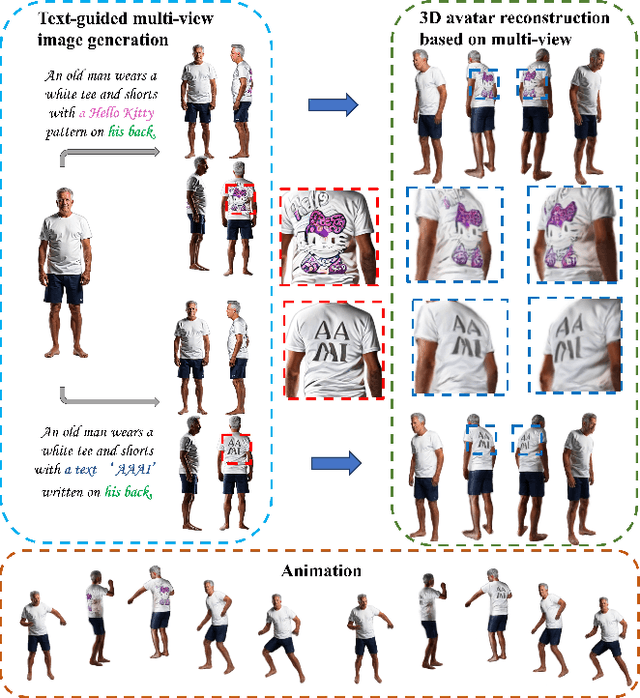
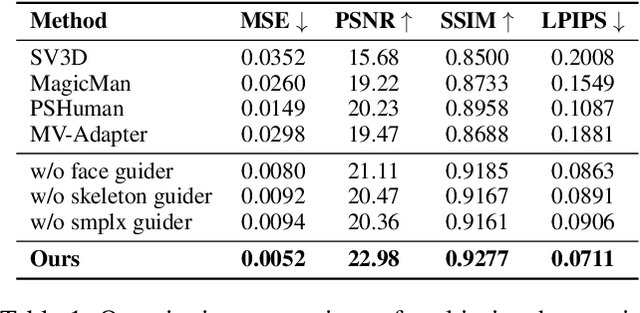
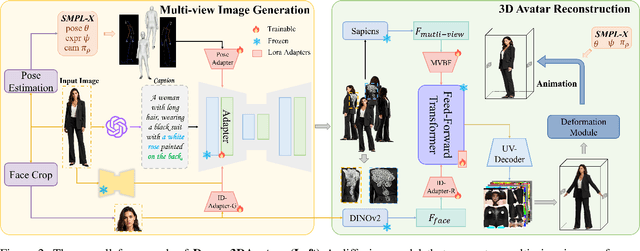
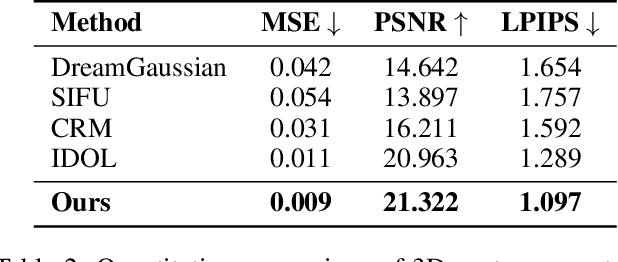
With the rapid advancement of 3D representation techniques and generative models, substantial progress has been made in reconstructing full-body 3D avatars from a single image. However, this task remains fundamentally ill-posedness due to the limited information available from monocular input, making it difficult to control the geometry and texture of occluded regions during generation. To address these challenges, we redesign the reconstruction pipeline and propose Dream3DAvatar, an efficient and text-controllable two-stage framework for 3D avatar generation. In the first stage, we develop a lightweight, adapter-enhanced multi-view generation model. Specifically, we introduce the Pose-Adapter to inject SMPL-X renderings and skeletal information into SDXL, enforcing geometric and pose consistency across views. To preserve facial identity, we incorporate ID-Adapter-G, which injects high-resolution facial features into the generation process. Additionally, we leverage BLIP2 to generate high-quality textual descriptions of the multi-view images, enhancing text-driven controllability in occluded regions. In the second stage, we design a feedforward Transformer model equipped with a multi-view feature fusion module to reconstruct high-fidelity 3D Gaussian Splat representations (3DGS) from the generated images. Furthermore, we introduce ID-Adapter-R, which utilizes a gating mechanism to effectively fuse facial features into the reconstruction process, improving high-frequency detail recovery. Extensive experiments demonstrate that our method can generate realistic, animation-ready 3D avatars without any post-processing and consistently outperforms existing baselines across multiple evaluation metrics.
Reasoning or Not? A Comprehensive Evaluation of Reasoning LLMs for Dialogue Summarization
Jul 02, 2025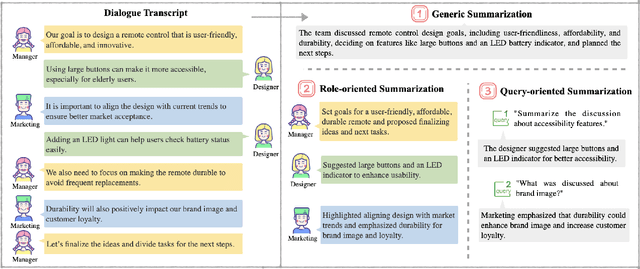
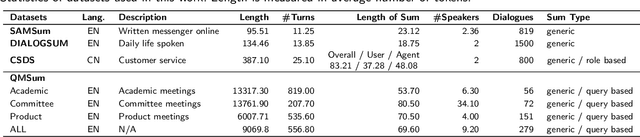
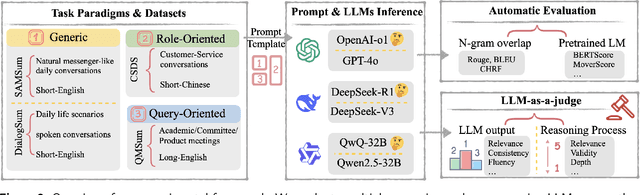
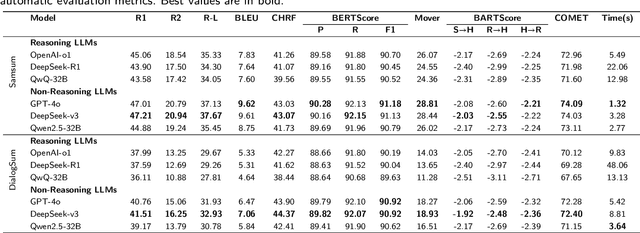
Dialogue summarization is a challenging task with significant practical value in customer service, meeting analysis, and conversational AI. Although large language models (LLMs) have achieved substantial progress in summarization tasks, the performance of step-by-step reasoning architectures-specifically Long Chain-of-Thought (CoT) implementations such as OpenAI-o1 and DeepSeek-R1-remains unexplored for dialogue scenarios requiring concurrent abstraction and conciseness. In this work, we present the first comprehensive and systematic evaluation of state-of-the-art reasoning LLMs and non-reasoning LLMs across three major paradigms-generic, role-oriented, and query-oriented dialogue summarization. Our study spans diverse languages, domains, and summary lengths, leveraging strong benchmarks (SAMSum, DialogSum, CSDS, and QMSum) and advanced evaluation protocols that include both LLM-based automatic metrics and human-inspired criteria. Contrary to trends in other reasoning-intensive tasks, our findings show that explicit stepwise reasoning does not consistently improve dialogue summarization quality. Instead, reasoning LLMs are often prone to verbosity, factual inconsistencies, and less concise summaries compared to their non-reasoning counterparts. Through scenario-specific analyses and detailed case studies, we further identify when and why explicit reasoning may fail to benefit-or even hinder-summarization in complex dialogue contexts. Our work provides new insights into the limitations of current reasoning LLMs and highlights the need for targeted modeling and evaluation strategies for real-world dialogue summarization.
A Real-time and Hardware Efficient Artfecat-free Spike Sorting Using Deep Spike Detection
Apr 19, 2025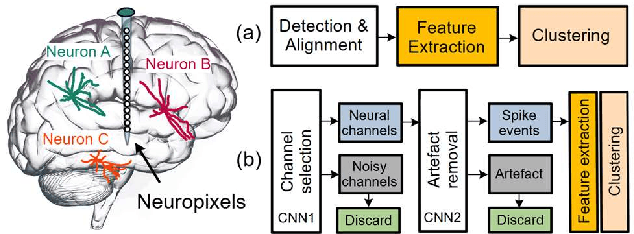
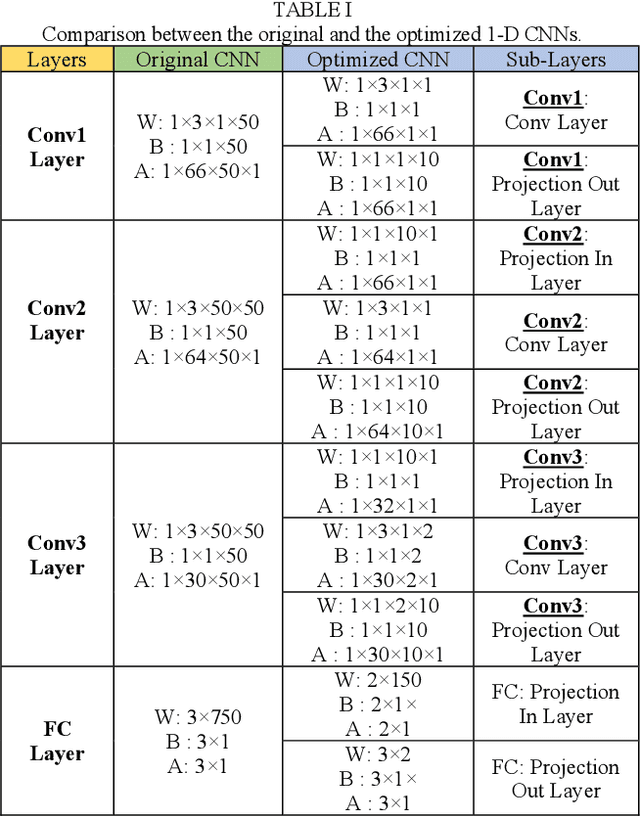
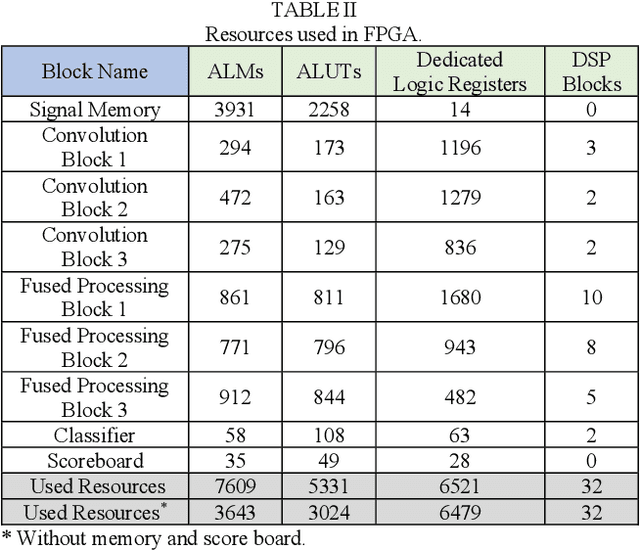
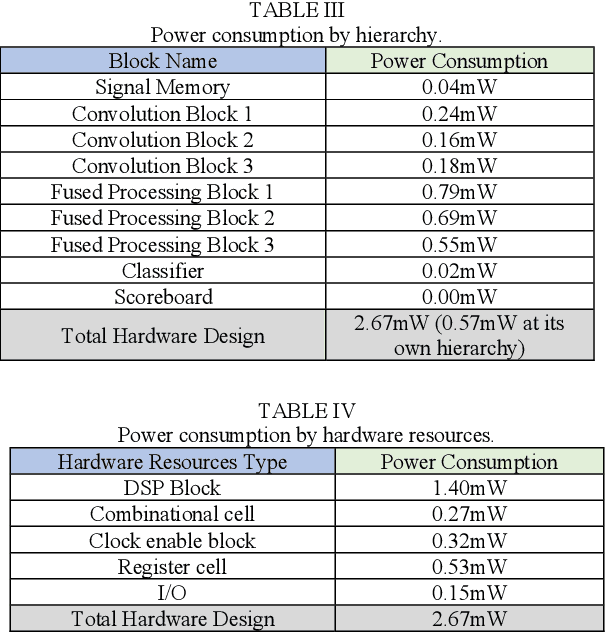
Spike sorting is a valuable tool in understanding brain regions. It assigns detected spike waveforms to their origins, helping to research the mechanism of the human brain and the development of implantable brain-machine interfaces (iBMIs). The presence of noise and artefacts will adversely affect the efficacy of spike sorting. This paper proposes a framework for low-cost and real-time implementation of deep spike detection, which consists of two one-dimensional (1-D) convolutional neural network (CNN) model for channel selection and artefact removal. The framework utilizes simulation and hardware layers, and it applies several low-power techniques to optimise the implementation cost of a 1-D CNN model. A compact CNN model with 210 bytes memory size is achieved using structured pruning, network projection and quantization in the simulation layer. The hardware layer also accommodates various techniques including a customized multiply-accumulate (MAC) engine, novel fused layers in the convolution pipeline and proposing flexible resource allocation for a power-efficient and low-delay design. The optimized 1-D CNN significantly decreases both computational complexity and model size, with only a minimal reduction in accuracy. Classification of 1-D CNN on the Cyclone V 5CSEMA5F31C6 FPGA evaluation platform is accomplished in just 16.8 microseconds at a frequency of 2.5 MHz. The FPGA prototype achieves an accuracy rate of 97.14% on a standard dataset and operates with a power consumption of 2.67mW from a supply voltage of 1.1 volts. An accuracy of 95.05% is achieved with a power of 5.6mW when deep spike detection is implemented using two optimized 1-D CNNs on an FPGA board.